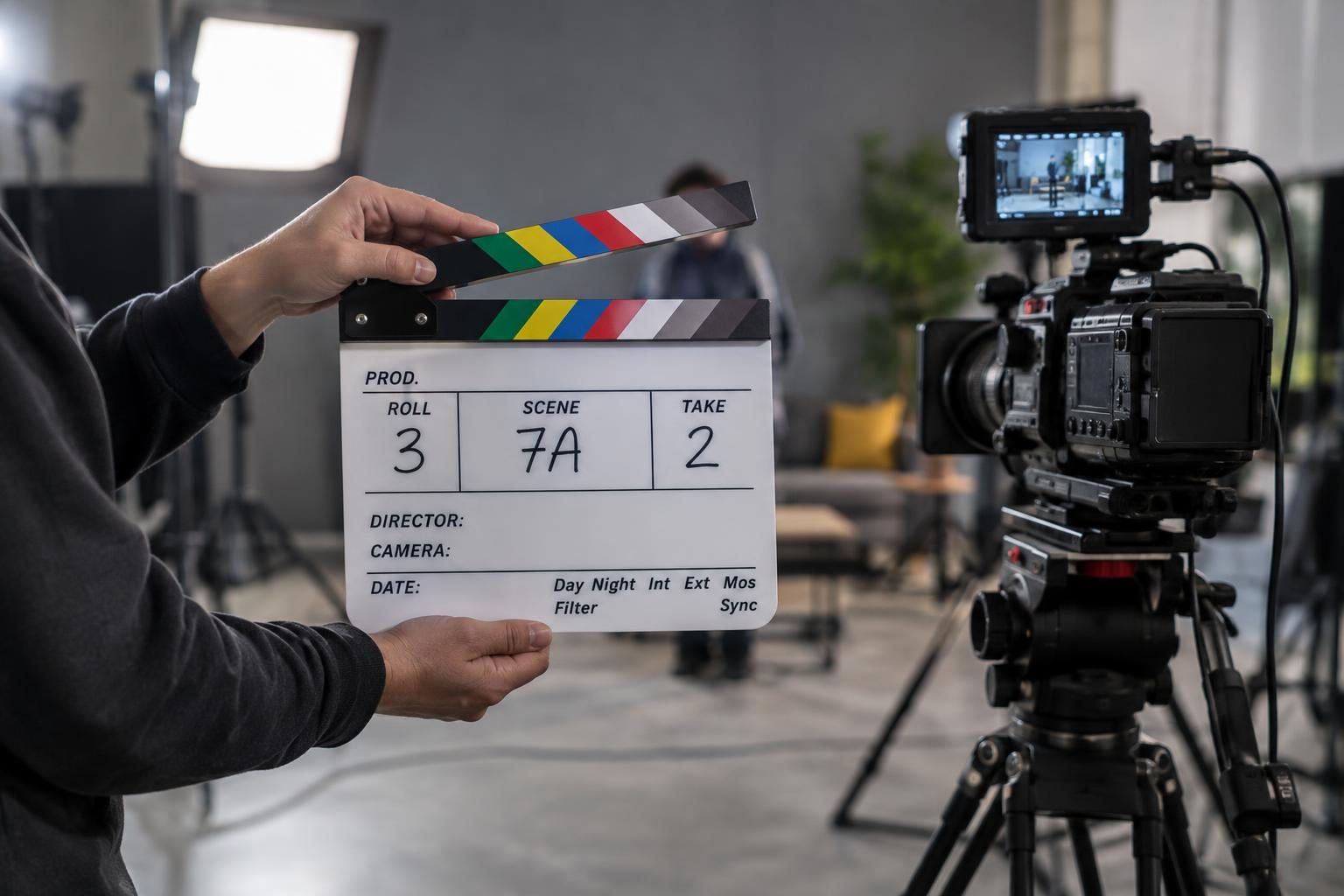
AI-generated photorealistic illustration · Created by Sellect Daily (AI); not an event photo.
Why the board—and the big clap?
The camera is ready. The actors are ready. Then someone puts a board in the way. An odd little interruption, until you see what it gives the editor.
A clapperboard helps synchronize picture and sound and identify scenes and takes. It isn’t just a dramatic way to announce that filming is happening. That little prop has paperwork to do.
The writing matters as much as the noise
Columbia University’s film glossary describes a take number shown to the camera and spoken into the soundtrack. Both records help with synchronization during editing. One number, recorded in two ways: the editor gets something to match, rather than a vague memory of which performance was which.
The slate can also carry the date, scene number, film title and camera operator’s name. Think of it as a label traveling inside the recording. This is a simple analogy, not a claim that every production uses an identical board or procedure.
The board labels the take; the clap helps picture and sound meet.
Follow one clap through the edit
Imagine two separate recordings of the same take. In this made-up timing example, the camera sees the sticks meet two seconds into its file. The sound recorder catches the clap five seconds into its own file. Different start buttons; one shared event.
| Recording | Where the same clap appears |
|---|---|
| Picture | 2 seconds from the start of the video file |
| Sound | 5 seconds from the start of the audio file |
| A matching point | Place that audio mark 3 seconds earlier relative to the video mark |
Now the visible closure and the recorded clap meet at the same point. That subtraction is the useful bit: the recordings needn’t have started together. It demonstrates a synchronization reference, rather than a complete editing procedure or a claim about a real production.
The writing handles another problem. If you have several performances, the scene and take labels help identify which files belong together before you match their timing. That tiny board is doing two quite different jobs. No wonder the editor wants a good look.
Tori gives the clap a second job
In our fictional explanation scene, Tori holds a practice slate while Toto checks a picture strip beside a sound track. Tori supplies the visible action; Toto looks for its sound. The scene illustrates synchronization, rather than recreating a real film set.

Toto would probably like every file to arrive perfectly labeled. Tori has brought a board instead. A wonderfully low-tech introduction to the same problem: which picture belongs with which sound?
This explains the slate’s basic purpose. It isn’t a complete production workflow or a claim that every modern recording needs a physical clapperboard.

Tori: “So the clap has an editing job waiting for it.”
An ordinary object can become a film artifact
Australia’s National Film and Sound Archive holds a clapperboard used on Oz – A Rock’n’Roll Road Movie, the 1976 feature directed by Chris Löfvén. Its collection account connects the object’s everyday production purpose with the history of that particular film.

Next time a behind-the-scenes clip shows a slate, look at the writing as well as the clap. A take number is a useful first thing to spot. The board may get only a moment on camera, but it has more to say than “look busy.”
Sources and scope
Checked against Columbia’s film glossary and the NFSA collection entry. Tori and Toto appear in a fictional explanation. An illustrative image is not documentary evidence of that film set.