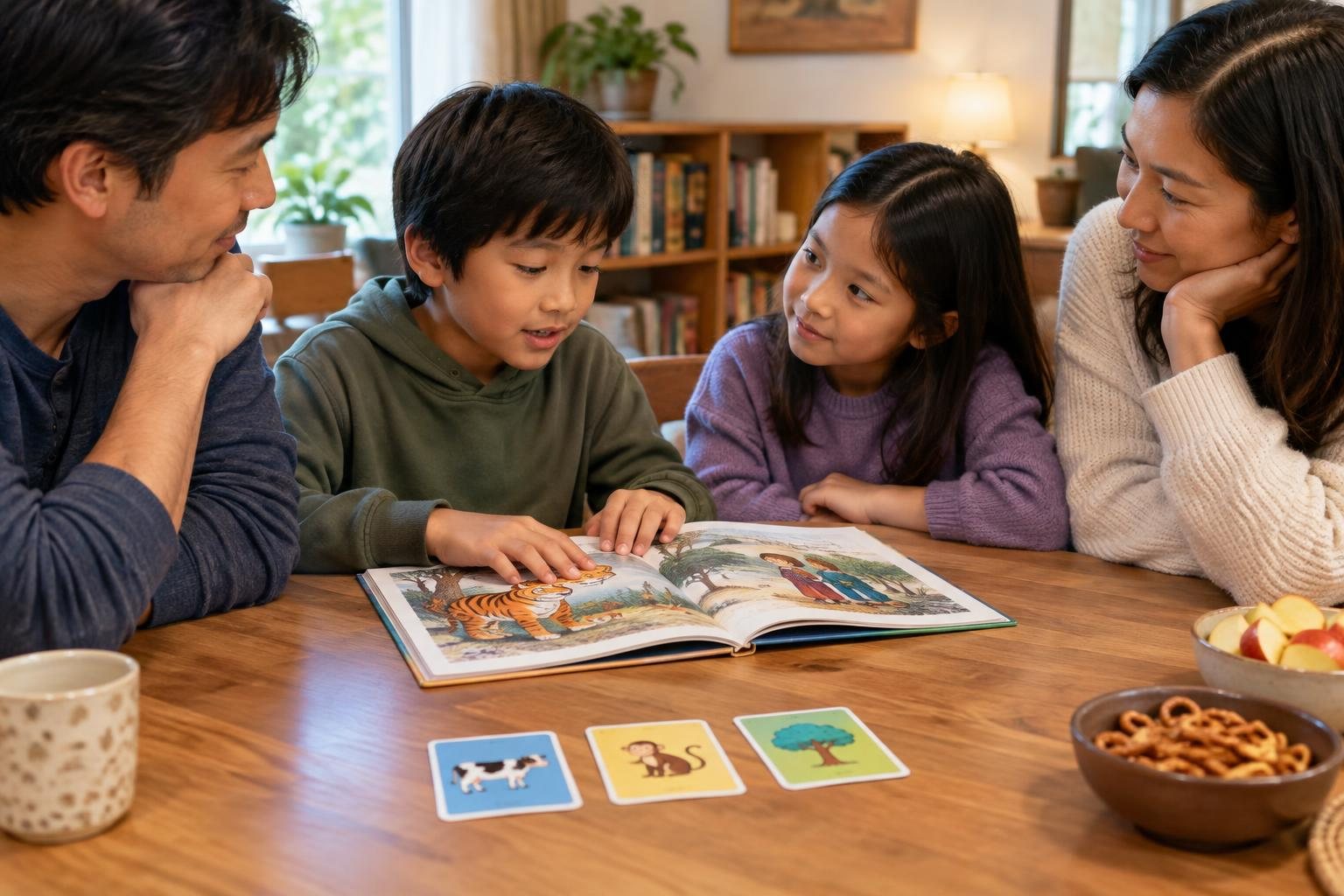
AI-generated photorealistic illustration · Created by Sellect Daily (AI); not an event photo.
A boy frees a trapped tiger. The tiger immediately says it will eat him. At the family table, someone asks, “Is that fair?” Suddenly the snack has a debate attached to it.
That is enough to begin. For World Philosophy Day on November 20, a family does not need a lecture, a textbook or one clever person with the “right” answer. Try one short story, one honest question and a round in which everyone gives a reason.
The tiger question is real—and the disagreement was useful
A UNESCO-backed philosophy-with-children pilot in Thailand used a folk story about a boy who rescues a trapped tiger. When the tiger turns on him, a student asks whether that is justice. Other students consider how a cow, a monkey and a fig tree see fairness differently.
They do not reach one neat consensus. UNESCO’s account says that was the point: the story opened dialogue and inquiry. The useful move was not guessing what the teacher wanted. It was noticing that the same event could look different from another position, then explaining why.
That makes the activity surprisingly home-friendly. You can borrow the shape without pretending to run UNESCO’s classroom programme: read something short, pause at a difficult choice, and ask a question that cannot be finished with yes or no.

Mochi has three answer cards and has already changed sides twice. Excellent. The cards are doing their job.
World Philosophy Day is about everyday thinking, not fancy vocabulary
UNESCO marks World Philosophy Day on the third Thursday of November; its 2026 page gives the date as November 20. UNESCO describes philosophy as both an inspiring discipline and an everyday practice. It connects philosophical thinking with intercultural dialogue, reasoned comparison of opinions, tolerance and respect.
That wording helps set the mood. A family philosophy circle is not a contest to see who can sound the most academic. It is a small practice in hearing a reason that is not yours. If a seven-year-old says the tiger broke a promise and an adult says the tiger never made one, both now have something specific to examine.
Keep the claim small: the three-step family circle below is an original at-home activity inspired by UNESCO’s discussion of dialogue and inquiry. It is not an official UNESCO lesson plan.
Try one story, one question and three listening rules
1. Pick a story with a real choice. A familiar picture book, folktale or five-minute made-up scene works. “Should the character tell the truth if it hurts a friend?” is more useful than “Was the story good?” Nobody needs to prepare research before dinner.

2. Ask for a reason, not a winner. Each person completes one sentence: “I think ___ because ___.” Younger children can point to a picture or choose between two cards first. The goal is to make thinking visible, not to stretch the evening until everyone regrets philosophy.
3. Repeat one idea fairly before adding yours. Try, “I heard you say…” and let the speaker correct the summary. Then add a different reason or say what changed your mind. Changing sides is allowed. In fact, it is often the most interesting moment in the room.
A good family debate does not end with a trophy. It ends with everyone understanding one more reason.
Give Tori and Coco different jobs
In our fictional table scene, Tori reads the tiger story aloud and places a “fair” card beside the boy. Coco chooses “not fair,” then has to explain whether the problem is hunger, betrayal or the promise the boy thought he had earned. Tori’s job is to ask one follow-up. Coco’s job is to restate Tori’s reason before answering.

Their cards are not a score board. They are parking spaces for ideas. When Coco moves a card after hearing a new reason, nobody has lost. The scene becomes warmer because changing your mind is treated as attention, not defeat.

Coco has not “lost” the debate. Coco has collected a better reason. That deserves the tiny aha face.
Four questions that work after the tiger goes home
- Is a promise still a promise if only one person thought it was made?
- Can something be fair to one character and unfair to another?
- When does helping someone create a responsibility?
- What would make you change your mind?
You only need one. Save the others for another day. World Philosophy Day can be a date on UNESCO’s calendar, but the useful habit is smaller and repeatable: ask, listen, give a reason, and leave room for a new one.
Official sources checked
- UNESCO, World Philosophy Day — November 20, the third Thursday of November, and the day’s emphasis on dialogue and reasoned thought
- UNESCO, What a trapped tiger can teach kids about philosophy — the Thai student pilot, tiger story and “Is that justice?” discussion
Sources checked November 7, 2026 (KST). The family circle is an original, informal activity, not an official curriculum or a claim that one conversation produces measured educational outcomes.
No one has to win. If the table gets one fair summary of someone else’s idea, that is already a lovely little result.